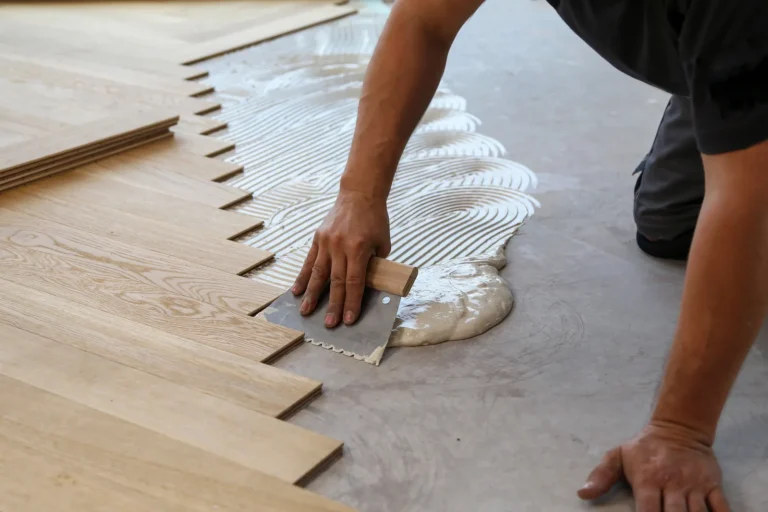
Everything You’ll Need
| Tool / Material | Solid Hardwood (Nail-Down) | Engineered Hardwood (Glue-Down) | Engineered Hardwood (Floating/Click-Lock) | Purpose |
|---|---|---|---|---|
| Tape Measure | ✔ | ✔ | ✔ | Measure layout and planks |
| Chalk Line | ✔ | ✔ | ✔ | Mark layout lines |
| Pry Bar | ✔ | ✔ | ✔ | Remove old flooring/baseboards |
| Moisture Meter | ✔ | ✔ | ✔ | Check subfloor moisture |
| Level | ✔ | ✔ | ✔ | Ensure even subfloor |
| Spacers | Optional | ✔ | ✔ | Maintain expansion gap at walls |
| Flooring Nailer / Stapler | ✔ | ✘ | ✘ | Secure solid planks to subfloor |
| Flooring Adhesive | ✘ | ✔ | ✘ | Glue engineered wood to subfloor |
| Trowel (for adhesive) | ✘ | ✔ | ✘ | Spread adhesive evenly |
| Click-Lock Installation Kit | ✘ | ✘ | ✔ | Includes tapping block, pull bar, spacers |
| Miter Saw | ✔ | ✔ | ✔ | Make crosscuts on planks |
| Jigsaw / Oscillating Tool | ✔ | ✔ | ✔ | Trim around obstacles |
| Safety Glasses | ✔ | ✔ | ✔ | Eye protection while cutting |
| Knee Pads | ✔ | ✔ | ✔ | Comfort during install |
| Underlayment / Vapor Barrier | Depends on subfloor/type | ✔ (moisture barrier) | ✔ | Reduces noise & moisture issues |
| Shop Vac or Broom | ✔ | ✔ | ✔ | Keep area clean while working |
Step 1: Prepare the Space
Remove Baseboards and Old Flooring
Start by taking out any current flooring and baseboards to see the subfloor. This prepares a clean area and lets the hardwood edges expand properly.
Use a pry bar to gently lift baseboards without harming the drywall so you can put them back later. Take out any carpet, vinyl, laminate, or old hardwood, and make sure to remove all old glue or staples completely.
Clean and Level the Subfloor
Sweep and vacuum the whole subfloor to get rid of dust, nails, dirt, or glue leftovers. Check for any dips or bumps using a straight edge or long level.
- For high spots: sand them down.
- For low spots: use a floor leveling compound to fill and smooth uneven areas.
A flat, even subfloor is important to prevent squeaking and ensure it lasts long.
Check for Moisture or Damage
Moisture is a common reason for hardwood floor problems. Use a moisture meter to check both the subfloor and hardwood planks.
- For wood subfloors: moisture should be below 12%.
- For concrete subfloors: follow specific limits, usually below 4% with a calcium chloride test.
If moisture is too high, stop installation and fix the problem before moving on.
Install Underlayment or Vapor Barrier (If Required)
Based on your flooring and subfloor type, you might need an underlayment or moisture barrier:
- Over concrete: use a vapor barrier or underlayment with moisture protection.
- Over plywood or OSB: a rosin paper, felt underlayment, or foam pad might be suggested.
Follow the manufacturer’s guidelines to avoid warranty issues and ensure the best performance. Lay the underlayment flat, without overlaps, and tape seams where necessary.
Step 2: Plan Your Hardwood Layout
Pick Your Starting Wall
In most rooms, run hardwood planks parallel to the longest or most seen wall to make the space look bigger and flow better. If you’re putting planks in several rooms, think about how they’ll line up through doorways and between spaces.
Snap a chalk line to mark a straight guideline along your starting wall. This keeps your first rows straight and helps the rest follow a straight line.
Let the Flooring Adjust
Before you start, let your hardwood planks sit in the room for at least 48 to 72 hours so they get used to the temperature and humidity. Lay the boxes flat in the room and open the ends to let air in.
This helps the wood fit the environment and lowers the chance of changes after installation.
Try a Dry-Lay First
Lay a few rows of boards without attaching them to see how your layout will look. This lets you:
- Make sure the layout looks even across the room
- Avoid narrow planks near walls
- Plan for things like vents or doors
Use this time to mix boards from different boxes to spread color and grain differences evenly on the floor.
Stagger Seams and Skip Patterns
For a natural look, stagger the ends of planks by at least 6 to 8 inches in nearby rows. Don’t use the same lengths or make “stair-step” or “H” patterns, as they can make seams stand out.
Tip: Change up your plank lengths and switch them around across rows for a more natural flow.
Figure Out Materials (Add Extra for Waste)
Measure your space (length × width) and add 10% for cutting waste, mistakes, and future fixes.
If your room is oddly shaped or you’re installing diagonally, increase the extra to 12–15%.
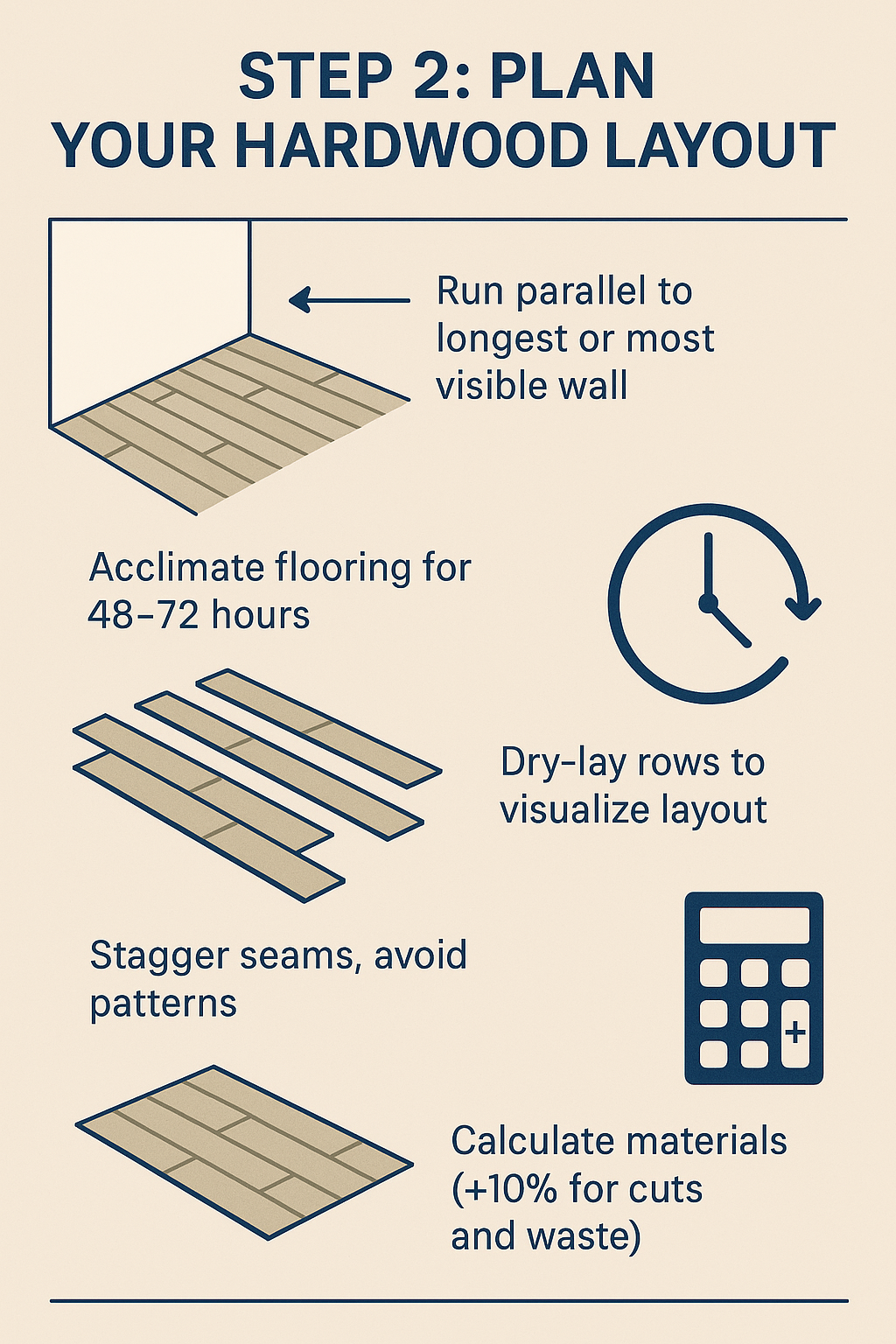
Step 3: Choose Your Installation Method
Before you start putting down boards, pick the best way to install your hardwood floor based on the type and the subfloor. Each way needs different tools and works best in different situations.
Nail-Down Installation (Common for Solid Hardwood)
This way works well for solid hardwood on a wooden subfloor like plywood. Use a flooring nailer or stapler to fix each board.
- Best for: Solid hardwood on wood subfloors
- Tools needed: Flooring nailer, mallet, air compressor
- Pros: Very secure and long-lasting
- DIY Difficulty: Moderate (needs precision and right tools)
Glue-Down Installation
Mainly for engineered hardwood on concrete, this way uses flooring glue to stick boards to the subfloor.
- Best for: Engineered hardwood on concrete
- Tools needed: Flooring adhesive, notched trowel, floor roller
- Pros: Strong bond and low profile
- DIY Difficulty: Moderate to high (messy and needs ventilation)
Floating Installation (Click-Lock)
Great for DIYers using click-lock engineered hardwood. Planks click together and “float” over underlayment without nails or glue.
- Best for: Click-lock engineered hardwood on any flat surface
- Tools needed: Spacers, tapping block, underlayment
- Pros: Fast, clean, beginner-friendly
- DIY Difficulty: Easy
Pro Tip: For solid hardwood on a wooden subfloor, nail-down is usually best. For engineered hardwood, many DIYers like floating floors because they are easier and need no tools.
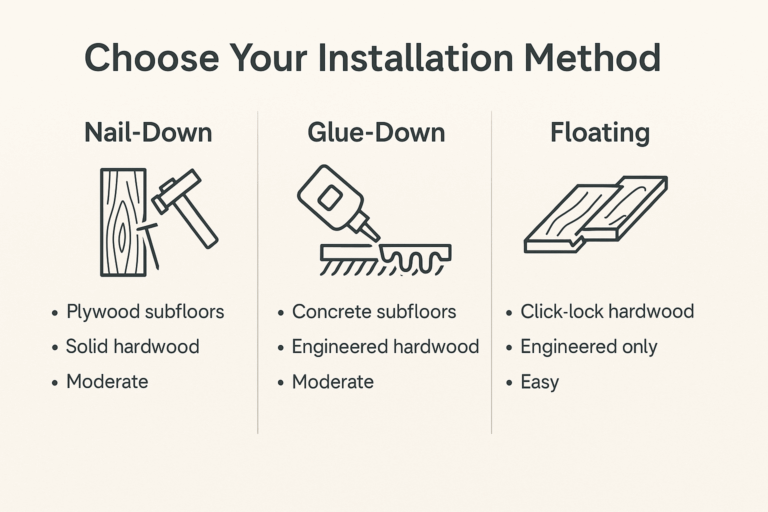
Step 4: Mark Guidelines and Snap Chalk Lines
Before you start, make sure to set a straight line to help with your flooring installation.
Mark a Chalk Line on Your Starting Wall
Find your starting wall, usually the longest or most noticeable wall. Measure one board’s width, including the gap for expansion, and mark a chalk line parallel to this wall. This will guide your first row.
Keep Rows Straight Using the Line
Align the boards with the chalk line as you work. This keeps the flooring straight and prevents it from shifting or curving.
Leave a 1/2″ Gap for Expansion
Wood changes with humidity, so leave a 1/2-inch gap using spacers between the hardwood and all walls, door frames, and fixed objects. This gap prevents buckling as the floor expands.
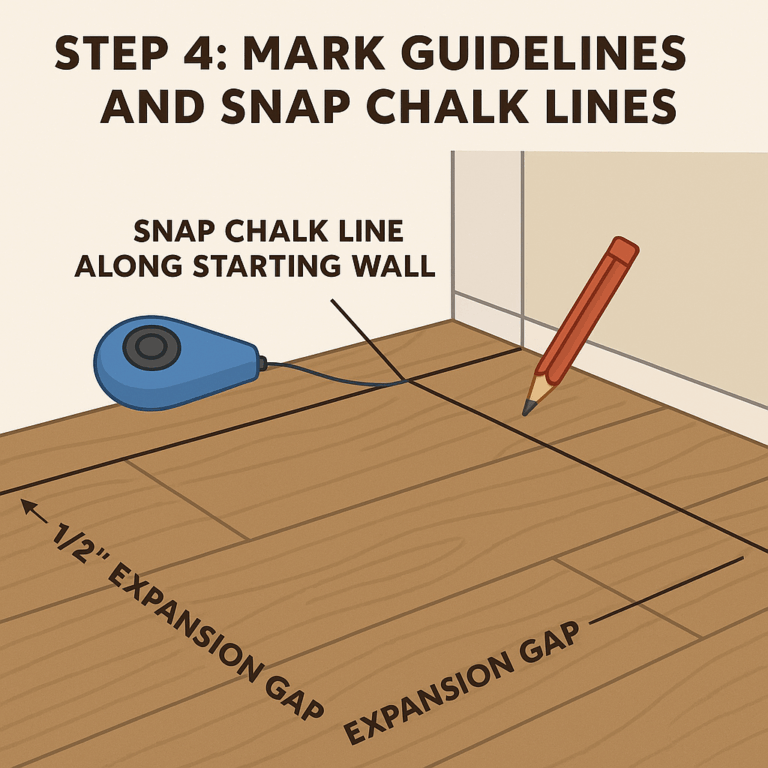
Step 5: Lay the First Row of Planks
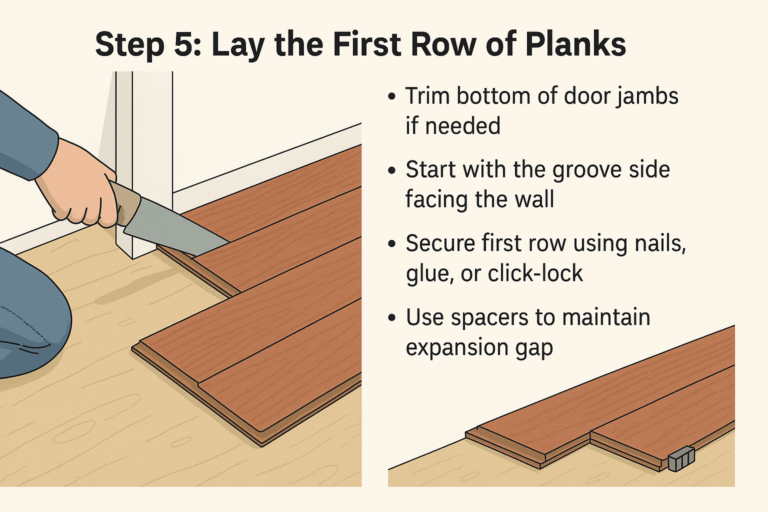
Trim Door Jambs if Needed
Before you put down the first plank, see if it needs to go under any door frames. Use a saw to cut the bottom of the door jambs so the planks fit without spaces.
Start with Groove Side Facing the Wall
Place the first plank with the groove side by the wall. This lets the next row’s tongue click into place easily. Start on the longest, straight wall to keep the flooring straight.
Secure the First Row
Depending on how you install:
- Nail-down: Use a nailer to fix boards to the subfloor through the tongue side.
- Glue-down: Spread glue with a tool and press each plank firmly.
- Floating (click-lock): Angle the second plank into the first and click to lock.
Make sure the planks fit tightly with no gaps.
Use Spacers to Maintain Expansion Gaps
Put 1/2″ spacers between the planks and the wall. This gap lets the hardwood expand and contract naturally, avoiding buckling or warping from humidity and temperature changes.
Step 6: Install the Remaining Flooring
After securing the first row, keep laying the hardwood planks row by row.
Stagger the End Joints for Stability
To make the floor strong and look natural, stagger the end joints by at least 6 inches. Do not line up joints in back-to-back rows because it can weaken the floor.
Use a Tapping Block for a Tight Fit
Put a tapping block on the edge of each plank and tap it softly with a mallet to close gaps. This makes sure each board fits snugly without harming the tongue or groove.
Secure Boards Based on Your Method
- Nail-down: Put nails through the tongue at a 45° angle every 6–8 inches.
- Glue-down: Spread glue evenly and press planks firmly.
- Floating floor: Click boards together end-to-end and side-to-side.
Check for Level Frequently
Every few rows, use a level to keep the floor flat. Adjust if needed to avoid problems later.
Step 7: Cut Boards to Fit Edges and Corners
When you reach the walls or obstacles, you’ll need to cut the last planks to fit perfectly.
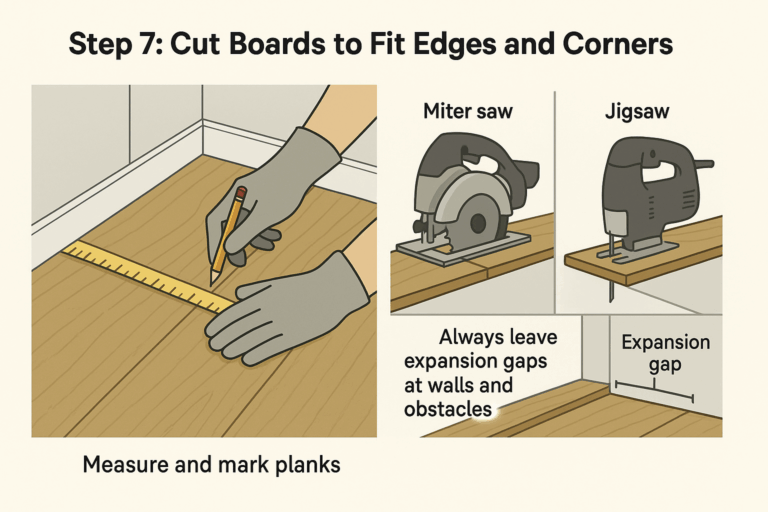
Measure and Mark Carefully
Use a tape measure to find the exact remaining space, subtracting 1/2″ for an expansion gap. Mark your plank with a pencil or chalk.
Use the Right Saw for the Job
- Miter saw: Best for straight cuts.
- Jigsaw: Good for curved cuts around vents or door frames.
Always cut on a stable surface and wear safety glasses to protect your eyes.
Maintain Expansion Gaps
Leave a 1/2″ gap between the flooring and all vertical surfaces, like walls and pipes, to allow for natural expansion and contraction.
Step 8: Reinstall Baseboards and Transition Strips
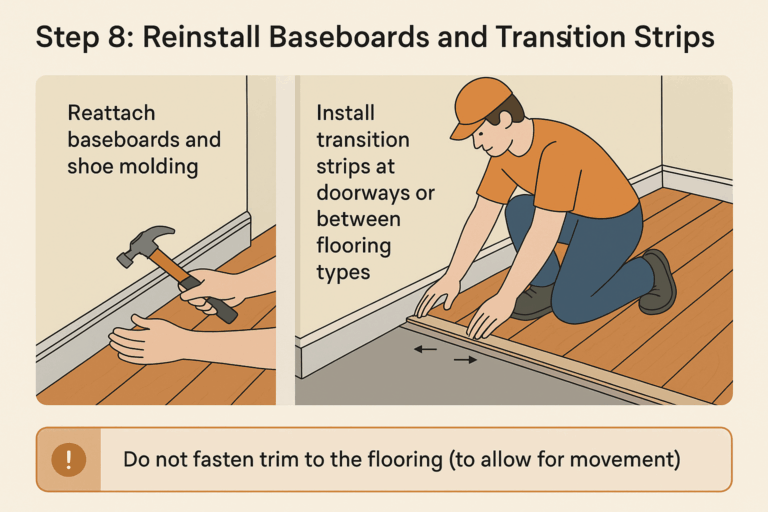
Put Back Baseboards and Shoe Molding
After laying down your hardwood planks, make the room look neat by placing the baseboards around the edges. If you had shoe molding before, put that back too for a nice finish.
Add Transition Strips
In doorways or where hardwood meets other floors like tile or carpet, add the right transition strips. Use T-moldings, reducers, or thresholds based on the height and type of the nearby floor.
Allow for Movement
When securing trim, don’t attach it to the hardwood floor directly. This allows for expansion and contraction and prevents buckling. Trim should be attached to the wall or subfloor, not the floating floor.
Step 9: Clean and Inspect Your Floor
After installation, clean and check your new hardwood floor to make sure it’s perfect before using it.
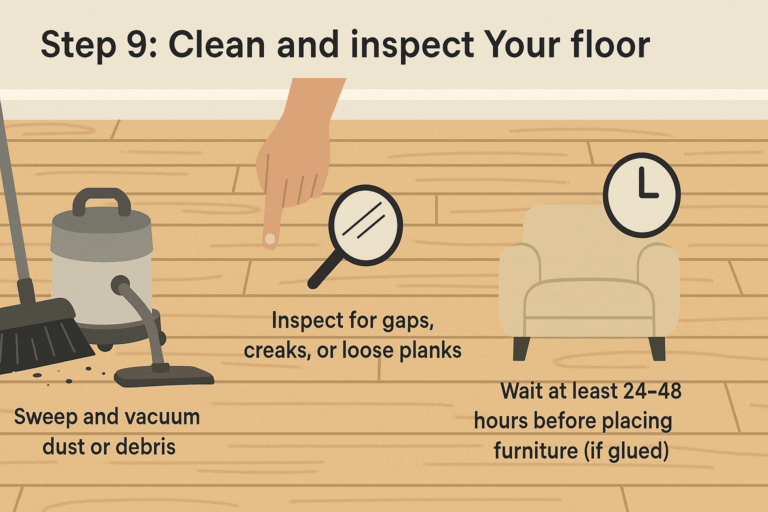
Sweep and Vacuum Well
Use a broom or vacuum with a soft brush to remove all sawdust and debris. This helps you see the floor clearly and avoids scratches.
Check for Problems
Look for gaps, uneven boards, or creaky sounds when you walk on the floor. Use a tapping block to fix any slightly misaligned boards or check your installation guide for help.
Let the Floor Settle
For glue-down installs, wait 24–48 hours before adding furniture or rugs. This gives the glue time to dry fully and keeps the floor from moving.
Pro Tips for a Successful Hardwood Installation
Getting good results with hardwood flooring needs careful prep and accuracy. These tips can help you work easier and avoid problems:
- Always check for moisture with a meter before installing to stop cupping or buckling later.
- Use knee pads to save your joints during long floor work, and make sure there’s good ventilation if using glues.
- Check alignment every few rows to keep planks straight and even.
- Work in small sections instead of rushing the whole room, which helps keep quality.
- Take your time on cuts. Clean, exact cuts are key to tight seams and professional results.
Common Mistakes to Avoid When Installing Hardwood
Even skilled DIYers can have problems if these common mistakes aren’t avoided:
- Skipping the acclimation period can make the wood expand or shrink after installing.
- Ignoring subfloor moisture and flatness causes instability, noise, or gaps.
- Not staggering seams weakens structure and makes it look uneven.
- Nailing too close to the edge of the plank can cause splits or cracks.
- Forgetting to use spacers leaves no room for expansion, leading to buckling.
DIY vs. Professional Hardwood Installation
Installing hardwood floors on your own can save money and be satisfying, but it might not be for everyone. Decide if you want to do it yourself or hire professionals.
DIY Pros:
- Cost is lower
- You control the pace
- Satisfaction from your work
DIY Cons:
- Hard work and takes time
- Needs careful planning and tools
- Fixing mistakes can be expensive
Professional Installation Pros:
- Quick and expert results
- Covers prep and cleanup
- Usually has warranties
Professional Installation Cons:
- Costs more for labor
- Less control over timing
📊 Side-by-Side Comparison Table
| Feature | DIY Installation | Professional Installation |
|---|---|---|
| Average Cost per Sq Ft | $3 – $8 (materials + tools) | $7 – $18 (includes labor) |
| Best For | Budget-conscious, handy homeowners | Busy homeowners, large or complex jobs |
| Time Commitment | Several days or weekends | 1–2 days (typical) |
| Risk of Mistakes | Moderate to high | Low |
| Tool Investment Required | ✔ | ❌ (provided by installer) |
| Satisfaction | High (if done well) | High (with professional finish) |
👉 For a full breakdown of costs, methods, and scenarios, visit our Hardwood Flooring Cost Guide
Do You Need Professional Help With Your Hardwood Flooring Installation Project?
Now that you know how to put in hardwood flooring, you can create a warm and classic look in your home. If you want to avoid the hard work like cutting and prepping, we can help.
Our skilled flooring installation team takes care of everything, whether it’s nail-down, glue-down, or floating hardwood. We ensure your floor is level, strong, and long-lasting without any effort on your part.
Contact us today to schedule your free in-home consultation and check if we serve your area!